Showing posts with label living the dream. Show all posts

Sunday, December 21, 2014

Food Tour: Kyoto, Japan

While in Japan, we purposely did not bother with a guide.  I figured our senses is our best guide.  The absence of someone initiated into Japanese cuisine allowed us to have a puritan experience.  We shaped our own impressions and experiences.  It is a little bit like grappling in the dark, but hey, monumental things come out of the blindest of tastings.  

Food isn't supposed to be a cerebral affair, and Japan brought us back to experiencing food that we do not know.  In Japan, food is visceral and perceptible.  But not incongruous to the Japanese people, its flavors are subtle and genteel,  polite and afraid to offend.  There is a plethora of colors, textures, and tastes beyond sushi and ramen.  In Kyoto, we tasted a lot of gently pickled vegetables, a lot of radishes, and a lot of gently pickled radishes.  Tea is evidently a religion, but so is sake, which, when served on a cold, soggy day, is unbeatable.  Fish is ubiquitous, but quality Japanese beef such as kobe and wagyu are priceless. The minute you pop one in your mouth and it will become obvious why.  And like chocolate is to the Swiss, Japanese sweets have centuries of tradition packed in that little colorful triangle dumpling.

Singapore claims to be the food capital of Asia.  I stand to debate that assertion.  After spending equal amounts of time in both countries, I dare say that Japan gets this one.

Nishiki Food Market
If there is one place to find everything that encapsulates Kyoto cuisine, Nishiki Market is it. Think Crash Course for Authentic Japanese Food.  Here you will find a gastronomical gamut of street food, fresh fish, dried fish, sashimi, seasonal fruits and vegetables, sweets, as well as some dry Japanese goods.  
The market is on five covered blocks which is perfect for days when the rain won't let up.  The place is charged with the electricity only found in places where massive amounts of food is available matched up with an equal massive amount of people in search of them.  In Italy and Paris, markets are also busy, but in Kyoto, vendors would be elated to have you try their food.  
And while you would be lucky to find English translations of hardly anything, you get to try everything out of sheer curiosity without your brain stopping you.  It could be a pile of deep fried octopus brain, and it could actually be a mind blowing sensation, which you wouldn't actually have tried if there was an English sign saying so. Now isn't that a wonderful thing?  
Sashimi (Fresh Raw Fish), Seafood
Enough Said.
At the one end of Nishiki Market, we watched an old, congenial Japanese fella shuck oysters. In his best (attempt at) English, he was making conversation all the while shucking oysters with a big deadly knife.  They have a small dining area and we knew we HAD to eat here.  It was lunch time after all!
We found seats at the cramped bar and it was a ridiculously insane meal with the freshest catch and not much else.  And those oysters!  They were enormous and had a sweet, salty but clean taste.
Kaiseki 
Kaiseki is an intimate traditional multi-course Japanese dinner showcasing seasonal food deftly prepared by a chef.  We went to Aunbo in the Gion district of Kyoto.  We went in cold, without a reservation and was greeted by the chef himself.  We were directed to enter an open, austere space with tatami floors after we have removed our shoes.  

They sat us at the bar where we sat on the floor facing a beautiful Japanese garden while the chef and a sous chef got busy with preparing our five course dinner.  It was a quiet weeknight when we came and there was no music playing.  The walls were bare.   I realized that this was all orchestrated in such a way that all our attention is focused solely on the carefully selected and prepared food.  Considering that it was a cold evening and we were walking around practically all day, the chef poured us some warm sake to go with our dinner.  

Five courses seem like a lot, but the servings are on the small side.  All courses are artfully prepared and carefully arranged on a plate.  The first course was an array of pickled vegetables and some roe (which was divine).  The second course was fresh fish, sashimi style.  Third course consisted of soup and fourth of steamed rice with little fried fish in it. The finale was tapioca pudding in coconut milk and red beans (which I had two servings of!).  
I'm not understanding yet the rhyme or reason to the order the food was served because it doesn't follow any Western standards.  But it felt good and right.   
 Japanese Beef (i.e. Wagyu, Kobe, etc.)
If you've had Kobe or Wagyu beef in your life, you will agree that the its flavor is one you are not bound to forget.  Japanese beef is topnotch and as such is very expensive.  It is often served in very thin slices, which is all you really need to appreciate its intense beef flavors.  
Full disclosure: We had this wagyu aged beef shabu shabu style in Osaka, not Kyoto.  We ran out of time in Kyoto, but there is a cornucopia of places that serve Japanese beef in Kyoto.  
Japanese beef is found in teppanyaki places where a chef sears the beef right in front of you.  You can also have it shabu shabu style where you cook beef and vegetables yourself in a hotpot.  You can also have it sukiyaki style where you sear the beef in a cast iron grill pan in front of you.  But why not try a steam bun with kobe beef filling?  For a steam bun, it is not cheap as it runs about 3.50 USD a pop.  But if you hate to splurge 50 USD on dinner, this is an easy way to satisfy your curiosity about Japanese beef.  We found these buns at the Nishiki Market and in the streets of Gion.   
Japanese Sweets a.k.a. Nama-yatsuhashi 
These can be found all over Kyoto and if you want to know a dirty little secret, I can't resist the urge to pop in them and have my fill at the free tastings.  Don't judge!
The Japanese are crazy about them, too!  In the Gion district of Kyoto, they serve tea as well so on a cold day like the day we were milling about, it's a madhouse!  My favorite shop is on the main pedestrian artery leading up to the Fushimi Inari.  They've been making these treats for 325 years and boy, have they gotten good at it!  
Ramen, Udon (of course) 
For what would be a trip to Japan without a piping bowl of ramen in thick, oily broth?  I'm a soup fanatic and I have a steadfast belief that sometimes, happiness and comfort can all be found but in a bowl.  This trip though was brief enough for all but two steaming bowls.
Unlike the gourmet status ramen has attained all over the world, in Japan, it is still a simple, humble affair, accessible to everyone.  This neighborhood ramen shop was all we could find open in our quiet neighborhood at Higashiyama in Kyoto at 10:30 PM.  It was a little divey and it looked like a no frills father-and-son operation.  Japanese TV was blaring with some incomprehensible program I can't follow if I tried.  There was a narrow bar fronting the kitchen where there were three enormous cauldrons under a steady fire. 
The Basement of Daimaru Department Store
If, for any reason, you don't make it to Nishiki Market (although that would be a fatal mistake), there's always the basement of Daimaru. Daimaru is a Japanese department store that is worth a visit if only for some duty-free shopping, particularly for Japanese brand cosmetics (think Shiseido and Shu Uemura).  Head down to the basement to witness food stalls serving bento boxes, tempura of all kinds, sweets, Japanese style deli, dried seafood, and all else unique and local.  The Japanese has also an indiscreet obsession with things French so it won't be uncommon to see French patisseries with long queues.  

Japanese cuisine is intriguing.  Contrary to Western interpretation of Japanese food, it is delicate and subtle.  I think what makes Japanese cuisine stand out is its honesty and integrity.  They are masters in making a dish outstanding without a slew of ingredients, spices and accoutrement that only successfully mask what is already, on its own, excellent.  Making seasonal ingredients and fresh fish taste exactly how it tastes naturally is art in its own right and that's why I have come to respect Japanese food.  In many ways, food purveyors are still artisans operating on a small scale offering on a plate all the years of homogeneous (for the most part) culture and tradition that no other country in Asia could match.      

Thursday, December 18, 2014

Postcards from Japan: Kyoto Temple Hop


We woke up to a wet, cold morning in Kyoto, Japan.  We had arrived the night before in Osaka from Manila and not long after, promptly jumped on the Japanese Rail (JR) train to Kyoto, where we will be spending the next two evenings sleeping on traditional futon mattresses laid on a tatami mat floor.  It had started raining as soon as we dropped off our bags about 10PM in search of a hot bowl of ramen which we judiciously found a few blocks from our guesthouse.  We would survive the soggy weather, thanks in part to an umbrella purchased from a 7-11 where we (joyously) found that the American dollar was stronger and the Japanese yen, weaker.  

I had no idea what to expect in Japan.  Our combined experience in travel though has prepared us that no matter what, wherever we find ourselves, we always survive and have a memorable time.  So why worry?  

My initial observations of Japan lack profoundness and sophistication, to be honest.  They were pretty rudimentary from:

1.  Wow. They really don't speak any English around here.  Maybe only 2%.  
2.  And.  Wow, they have the best toilets in the world.  Think very clean, heated seats, standard built-in bidets with adjustable pressure, noise-concealers.  At the Intercon in Osaka, they had those that are like soldiers that suddenly stand in attention and salute when you walk into the cubicle (where the doors are actual, real doors, mind you).
3.  And. Wow, this must be the cleanest country I have ever set foot on.  The train stations were brimming with people, even late at night, and yet, there would be no litter, pee smell or graffiti typically found in train stations everywhere else.  It's utopia for germophobes!

We had no time to spare so rain or shine, we set off with our umbrella, our guidebook and not much else to explore Kyoto.  We've never traveled to any country where our itinerary comprised mostly of hopping from one temple to the next.  But in Kyoto, there are seventeen sites that belong to the UNESCO World Heritage List, most of which are temples.  If we were to try to delve as much as we can into Japan's rich heritage and culture, we might as well visit a few temples.   

The temples we visited were old, but they were all working temples to this day.  It wouldn't be unusual to observe Japanese pilgrims perform their religious rituals - tossing a coin into a tray, uttering a silent prayer, then subsequently ringing a bell a hanging from a ceiling, and then clapping twice.  Prayer cards and wishes written on paper or drawn on small planks would be tied to beams fronting the temples.  Incense and candles would be burning outside. 

Fushimi Inari
Fushimi Inari's over a thousand orange gates is one of Kyoto's well known icons.  If you've remember watching Memoirs of a Geisha, this is where Sayuri ran off to the first time she met the Chairman as a young girl.  It is located in the southern part of Kyoto, on a hillside, and is one of the most important Shinto temples in Kyoto.  The gates themselves are "purchased" by companies and the markings behind each one would say who the "donation" came from. 
As previously mentioned, the weather was pretty wet and dismal, and as much as we wanted to trek to the top of the hill, we had to throw the (wet) towel in.  
The pedestrian streets leading to Fushimi Inari were very quaint and were lined with all sorts of Japanese cafes and shops, my favorite of which was a place that sold only chopsticks which they will engrave your names for your for free!  We were also on the hunt for Vermillion, a revered neighborhood cafĂ©, but we happened to be there on a Thursday, the only day that place was closed. 
Kinkaku-ji (Golden Temple)
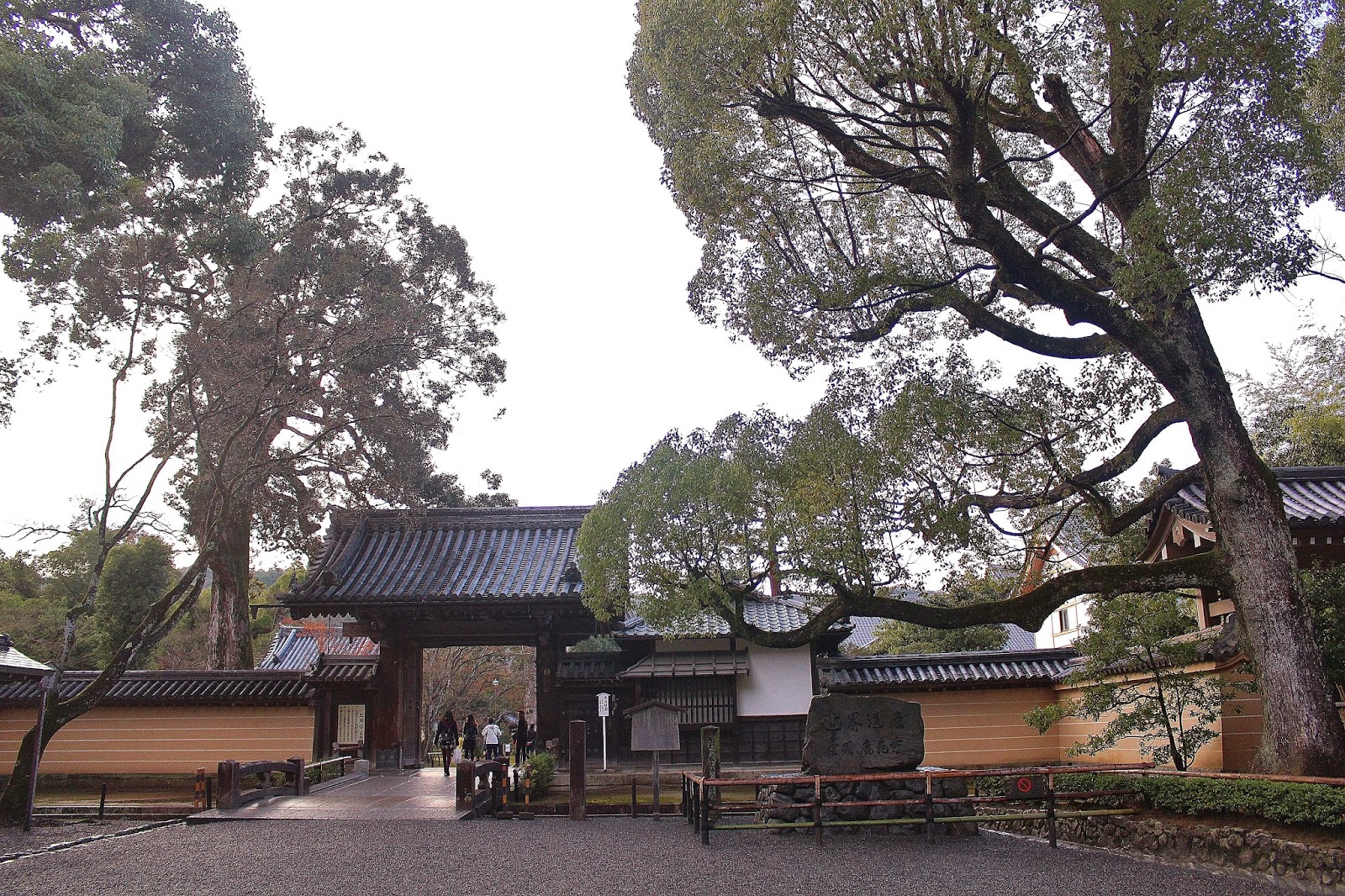
Kinkaku-ji is in the northwestern edge of Kyoto which we got to by subway, and then driven to Kinkakuji itself by an overeager Japanese taxi driver (yes, they exist) who would punctuate every attempt at broken English by an endless and repetitive string of "Hai!  Hai!".
Kinkaku-ji was initially intended to be a villa, but subsequently converted into a Zen temple.  If it looks like this pavilion is gleaming, it is because it is.  It is cloaked in gold.  The rain had stopped and we arrived just as the sun was setting, which accentuated the temple's golden glow.  It was heart-stopping to see in real life, especially since there were no other competing structures around it.  I especially love the lush mountains behind it.  
There is a path that goes around the temple and behind with beautiful surroundings, some statues, and before the exit, a temple.  We noticed a lot of students on a field trip, some pilgrims and tourists, but also had a Karate Kid sighting!  
Kodai-ji Temple
We wandered all over Gion at dark and ran into a couple of landmarks, which during this time of the year, were all lit up.  We had no intention of sightseeing further after dinner, but it was difficult to peer away from these mysterious temples.  We didn't walk inside the Kodai-ji grounds, but I guess within is a garden created by one of Japan's most famous garden designers.  At one of its entrances are steps flanked by pretty trees on either side and a bamboo grove on one side.
Otani Hombyo
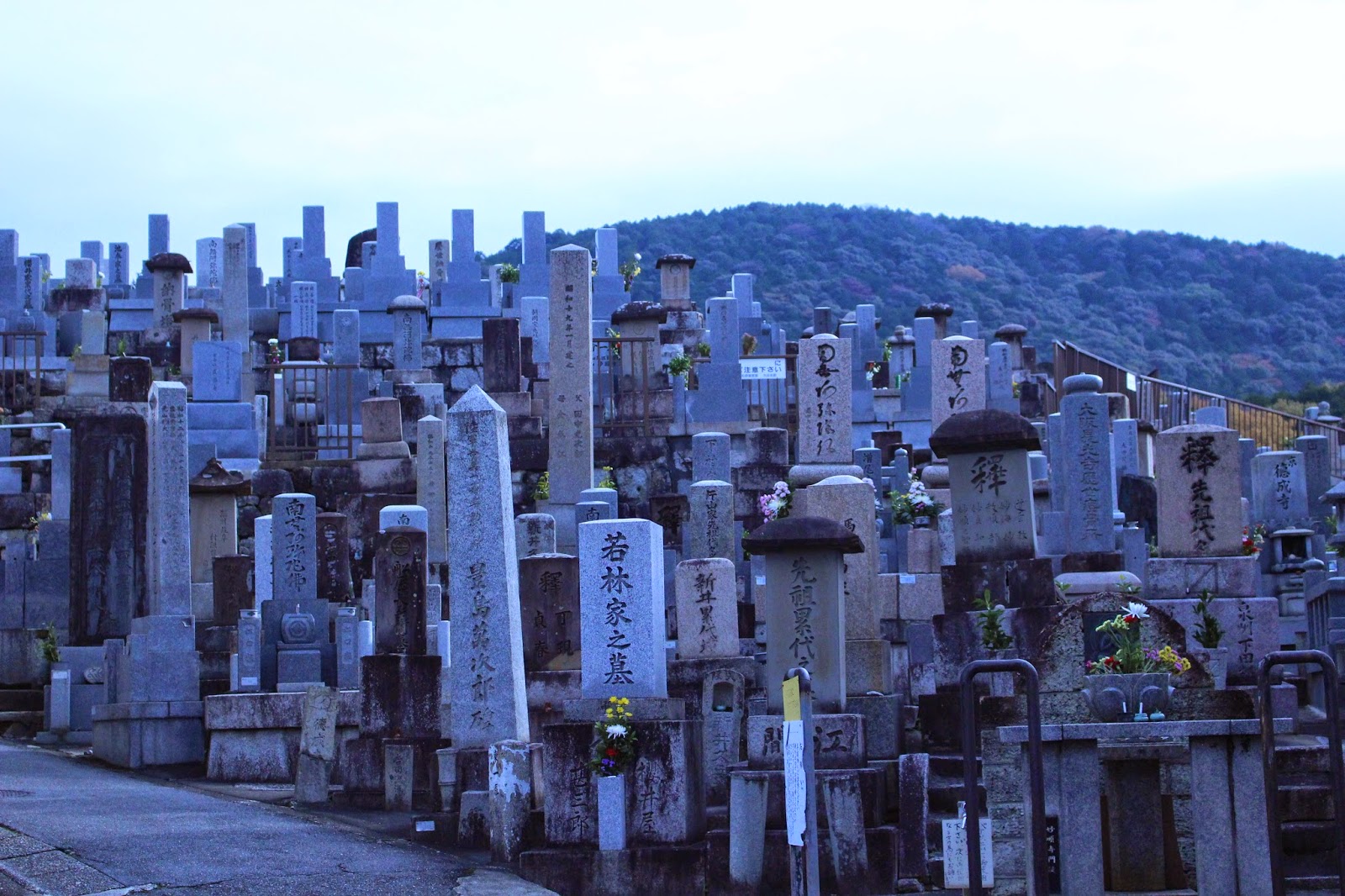
This is technically not a temple, but a mausoleum dedicated to Shinran Shonin, founder of one of the Buddhist traditions called Jodo Shinshu.  We stumbled upon it trying to find Kiyomizu-dera.  We were urged by a security guard to come in and explore, so why not?
Behind it was this Japanese cemetery.
Kiyomizu-dera
This was the most crowded temple we've been to.  There's something to be said about its location which sits on top of a hill overlooking Kyoto.  It is again one of Kyoto's sites of historic importance that is registered on the UNESCO World Heritage list.  One of the buildings in this compound is also supported by wooden pillars constructed without any nails.
The Japanese have a talent for incorporating nature's aesthetics into their places of worship that really, it felt just like walking through gardens.  Temples also showcase Japanese architecture and woodwork.  I wished though that the people who ran the temples did more to capture the imagination when they wrote visitor's guides and flyers.  Some of them had very minimal information about the history of the temples and I wonder if more in-depth information was available, just in Japanese.  Unlike in Italy where visiting cathedrals and churches felt like a history lesson after another, I found Kyoto a little lacking in this department, although the potential is huge.

Also, I had a curiosity to see what is actually inside the temples, except they actually don't allow it (not that I tried).  It would be a deeper cultural experience to actually get a sense of what goes on inside as opposed to just admire from the outside.

Up next.. the reason why I decided to drag The Dutch to Japan: Food.

P.S.  Did you see Huffington Post's article on Japan's must-see UNESCO Heritage Sites today?  Plan your trip to Japan now!

Tuesday, December 16, 2014

Thanksgiving in Asia

We are back from two weeks in Asia!  Jetlag has always been such a brutal bitch to me, but it’s a small price to pay for seeing the world.  I often get sympathetic groans from people who find out my holiday is ending.  "Back to reality," they would lament.  But really, the reality I come back to is not a bad one.  Seriously!  While it’s always a fantastic adventure to travel and see the world, there is nothing quite like being back home, to sleeping and waking up in my own sun-filled bed, showering under my shower, making home-cooked meals in our just-revamped kitchen.  Even going back to work and submitting to a routine again ain't all that bad.  And this time, we also came home to snow which is forever a magical thing!
But what an amazing two weeks it has been, traveling back to motherland, the Philippines, and also to two countries I've never been before - Singapore and Japan.  It was a pretty intense two weeks with  trying to visit with as many family and old friends as time would permit.  We also dodged a super typhoon that missed Manila by a hair.  But ultimately, the two weeks was what I needed those two weeks to be.
We were in Manila for a couple days to spend quality time with the family, then immediately headed out to Panglao, an island in Bohol, a mere hour flight south of Manila.  Panglao was a revelation to the Dutch – but even for myself who grew up in the Philippines! Boracay is one of the Philippines’ top beaches, but because of that, it is also touristy, crowded, and very commercialized.  I chose to go to Panglao in Bohol because of its relative seclusion.  Bohol is also the home of chocolate hills and the tarsier, the world’s smallest primate endemic to the Philippines – and both of these are worth a side trip! 
After returning to Manila from Bohol, we flew to Singapore for a few days.  The Dutch has a few meetings there and it was a golden opportunity for him to drag me along (which he has always dreamed of doing).  My expectations of Singapore were very low and it sadly, it lived up to my (low) expectations.  But more on that later. 
Our final stop before heading home was Japan.  It had to take a lot of cajoling for The Dutch to agree to this Japan leg, but the minute we set foot on the train to Kyoto, we were both bewildered.  Japan was wild!  It was efficient and very clean with impressive toilets, yes, much like Singapore, but it was oozing with culture from its every single orifice (not very much like Singapore).  Japan was also a country neither of us has been before so it was a wonderful experience to explore and try to absorb, process and understand everything together. 

There will be a bombardment of new blog posts filled with photo diaries since I'm officially over my jetlag, thanks to a brutal hour at spinning class tonight.  I might just give precedence to Japan because of the aforementioned and simply because it is on the forefront of my cerebral cortex.  

On a final note... let me just say again that it's good to be back home a week before Christmas.  But more than ever, it's good to have gone home.